Oticon Intent - a hearing aid that understands you
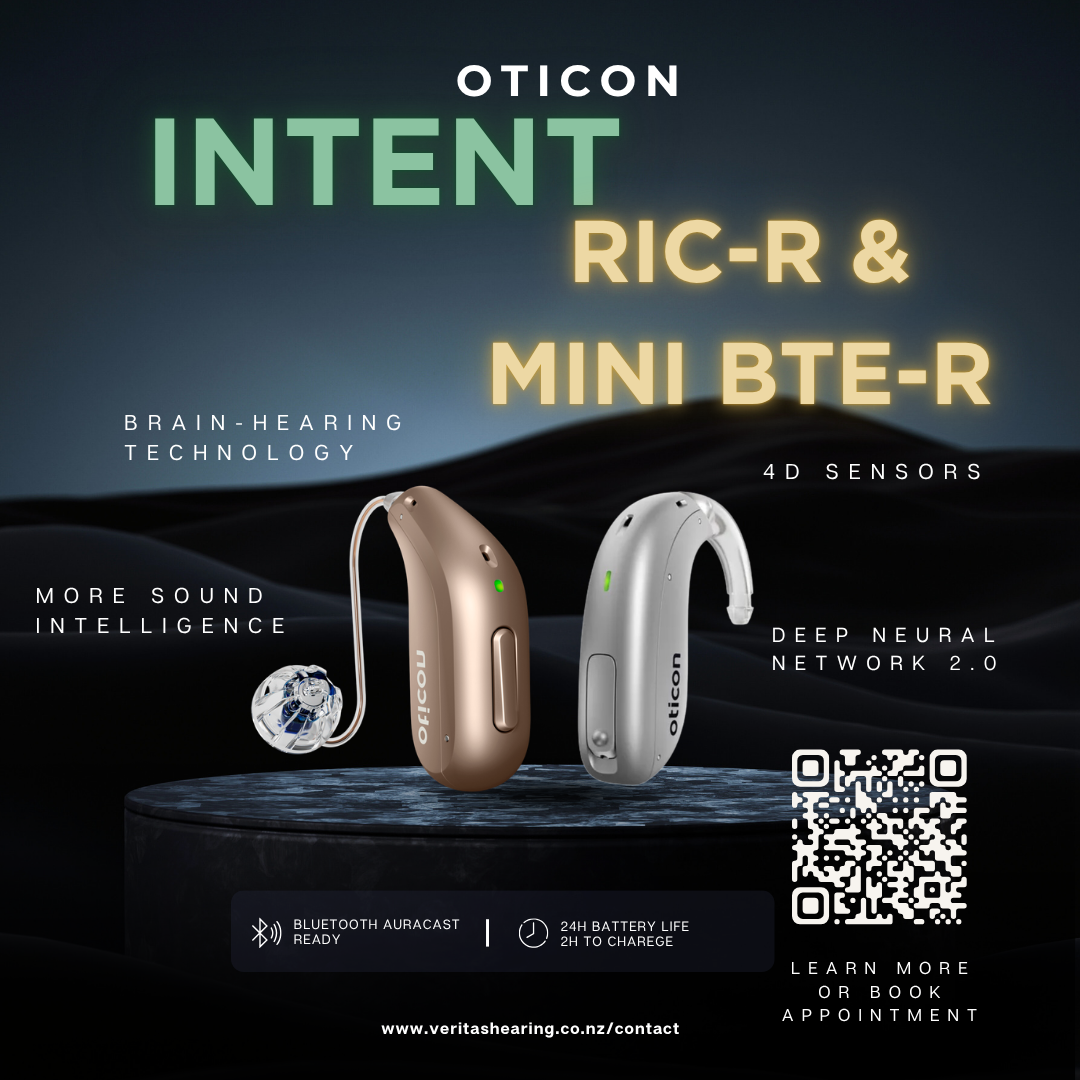
The Oticon Intent is a small device with a big idea: your hearing aid should understand what you're trying to do — not just react to the sounds around you.
If you or someone you love has hearing loss, you'll know the quiet exhaustion of noisy places. A family dinner. A birthday party. A busy café where you're nodding along but catching maybe half the words.
It's not just frustrating — it's genuinely tiring. Your brain is working overtime to fill in the gaps, which is why so many people with hearing loss come home from social gatherings feeling drained rather than uplifted.
For years, hearing aids have helped by amplifying sound and filtering out background noise. And they've come a long way. But they've always had a blind spot: they respond to the sounds in the room, without any understanding of what you're actually trying to do in that moment.
That changes with the Oticon Intent.
The moment that matters
Picture yourself at a dinner party. You lean in to catch what your friend is saying. A moment later, you glance up and turn your head as a friend walks through the door. Then you turn stand up to greet them. In each of those moments, what you need from your hearing aid is completely different.

The Oticon Intent is designed to recognise exactly these kinds of shifts — and adapt automatically, without you lifting a finger.
It does this using something called 4D Sensor technology. Inside the hearing aid are sensors that are constantly picking up four types of information about you and your environment.
How your head is moving
Turning to follow a conversation? The aid reads that as a signal you want to catch a new voice.
How your body is moving
Walking through a crowd? The aid opens up your awareness of everything around you.
Whether speech is present
Is someone talking in front of you? The aid knows — and focuses its energy there.
How noisy the environment is
The louder and more complex the background, the more support quietly kicks in.
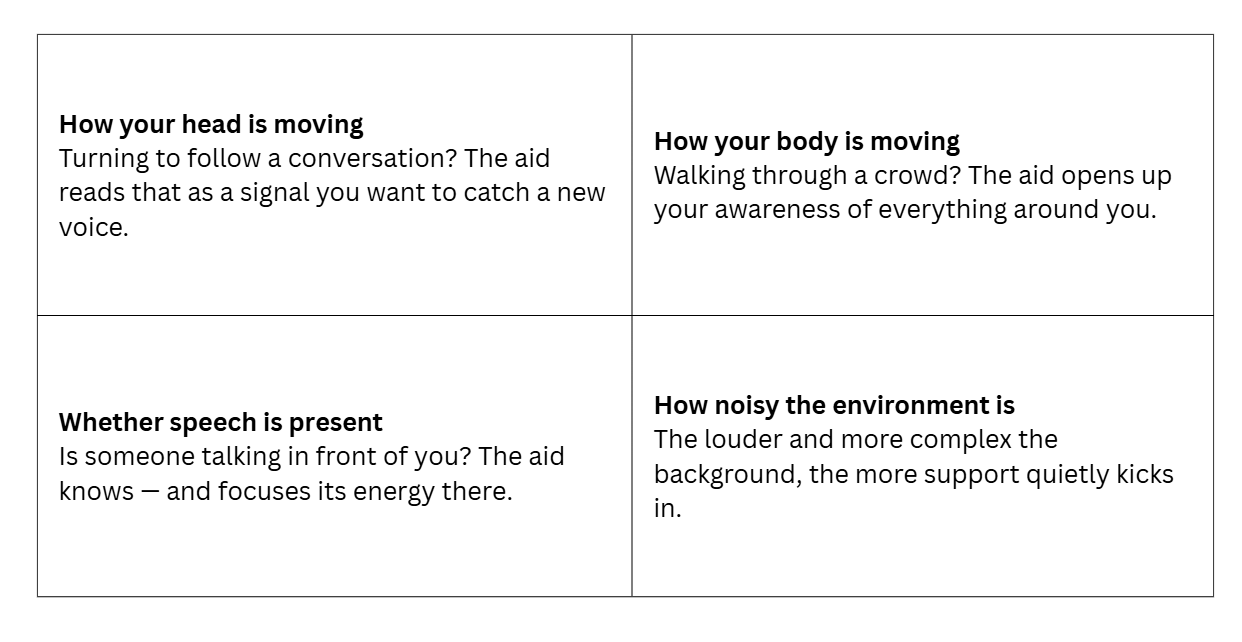
These four streams of information are combined, moment by moment, to build a picture of your listening intention. The hearing aid then adjusts how it processes sound accordingly — smoothly, continuously, and without any abrupt jumps.
When you're still, it sharpens. When you're moving, it opens up.
Here's what that looks like in practice. When you're sitting still, focused on a one-on-one conversation, the Oticon Intent brings that voice forward — making it clearer and more distinct from the background noise. When you're up and moving, perhaps navigating a room at a party, it softens that focus so you stay spatially aware — you can hear where sounds are coming from and respond naturally to your environment.
This might sound subtle, but the difference it makes is significant. Having to constantly adjust your hearing aid settings, or remove yourself from noisy situations, or ask people to repeat themselves — these things add up. Technology that handles it quietly in the background gives you the freedom to just be present.
AI that learned from real life
The other major innovation inside the Oticon Intent is a next-generation AI system called Deep Neural Network 2.0. Think of it as a highly trained listener. It was taught to distinguish speech from noise by processing thousands of real-world sound scenes — restaurants, offices, outdoor environments, busy streets — in full 360-degree detail.
The result is that it has an exceptionally fine-grained sense of what speech sounds like, even when it's buried in background noise. It suppresses what you don't need, preserves what you do, and does so without introducing the tinny or artificial quality that can make hearing aids feel unnatural.
What the research shows
35%
more access to speech cues vs. previous generation
5 dB
wider range of adaptive support in the same environment
58%
speech intelligibility even when noise equals speech
That last number is worth pausing on. In a scenario where the background noise was just as loud as the person speaking — genuinely difficult conditions — the Oticon Intent gave wearers a 58% speech intelligibility score. By comparison, a person with normal, unaided hearing would only reach around 40% in the same conditions.
Better hearing is about more than sound
Oticon's approach is built around a concept they call BrainHearing — the idea that a hearing aid should work with how your brain naturally processes sound, rather than oversimplifying that process. When your brain isn't straining to piece together a conversation, you're more relaxed, more engaged, and more like yourself.
If you've been putting off looking into hearing aids, or if you've tried them before and found them lacking in noisy situations, it's worth knowing how much the technology has moved forward. The goal has always been to help you stay connected to the people and moments that matter. The Oticon Intent is a meaningful step closer to that.
Thinking about whether a hearing aid like this could be right for you?
Speaking with an audiologist is a great first step — they can assess your specific hearing needs and help you find the right fit.
Book your appointment with Veritas Hearing
Read review from Hearing Tracker: Click Here
Watch review from Hearing Tracker: Click Here
Watch review from Applied Hearing: Click Here
Read Oticon White Paper: Click Here